Performance Monitoring: Collecting APM Data
Given the following Flask app, instrument this using Datadog’s APM solution:
To produce a substantial body of transactions, I used a database-intensive Flask app called eNMS (https://enms.readthedocs.io/en/latest/ ) to produce a burst of transactions.
in that case, I leveraged the automatic instrumentation provided by the Flask integration using ddtrace-run from the shell:
$ ddtrace-run gunicorn --config gunicorn.py app:app
In the case of Flask, the ddtrace module automatically registers hooks and wraps tracers around functions that have requests.
Because using both ddtrace-run and manually inserting the Middleware has been known to cause issues,
I have included an example of a manually-instrumented app below.
from ddtrace import patch_all
patch_all()

from flask import Flask
from loguru import logger


app = Flask(__name__)

""" This minimal app invokes the ``ddtrace`` module."""
@app.route('/')
def api_entry():
        logger.info("Welcome to Zero2Datadog")
        return 'Entrypoint to the Application'

@app.route('/api/apm')
def apm_endpoint():
        logger.info("Starting the APM")
        return 'Getting APM Started'


@app.route('/api/trace')
def trace_endpoint():
        logger.info("Posting a Trace")
        return 'Posting Traces'


if __name__ == '__main__':
        app.run(host='0.0.0.0', port='5050')
Dashboard: Unified APM and Metrics
Provide a link and a screenshot of a Dashboard with both APM and Infrastructure Metrics.
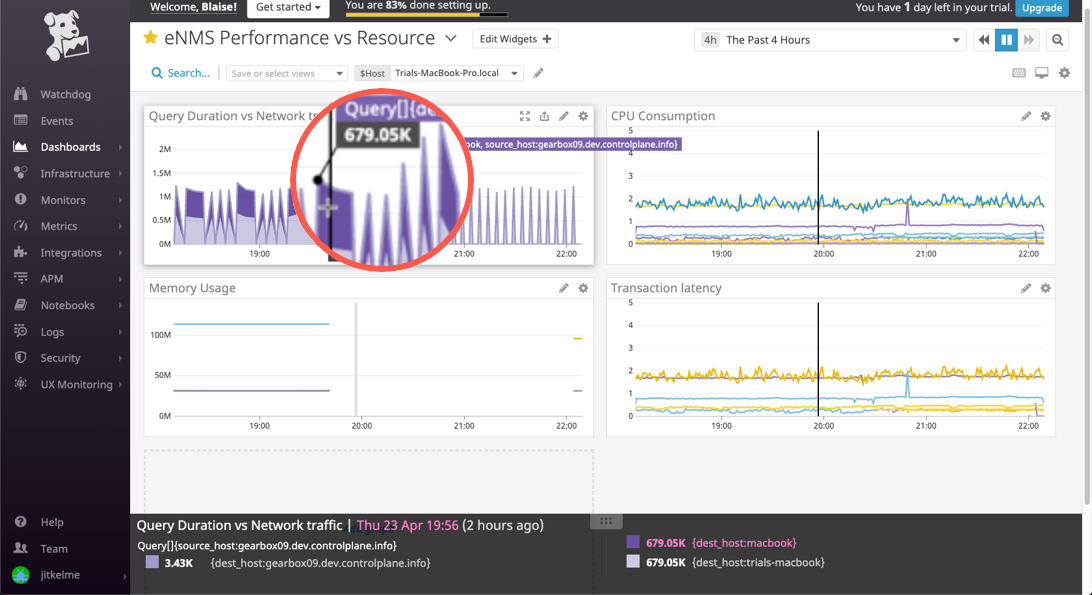
This dashboard illustrates network traffic levels in conjunction with database queries (e.g. trace.sqlite.query.duration).
The dashboard is accessible at:
https://p.datadoghq.com/sb/tete840uvd9y7dkj-1f06d1c161aec5dd0c7c306ead78ab2e
Bonus: Service vs Resource?
What is the difference between a Service and a Resource?
- Resource
A resource is a particular action for a given service (typically an individual endpoint or query). A helpful mnemonic could be: A service…provides (serves) a resource
- Service
Services are the building blocks of modern microservice architectures. Broadly speaking, a service groups together endpoints, queries, or jobs for the purposes of scaling instances